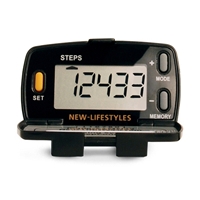
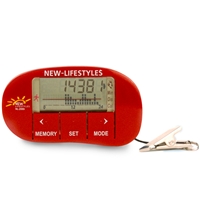
From Tommy Thompson to Ronald McDonald™, everyone seems to be step counting these days. But what separates the tools from the trinkets? Let's look inside popular pedometers and find out.  
ACC - Accelerometer | SLA - Suspended Lever Arm | HS - Hairspring | CS - Coil Spring
MRS - Magnetic Reed Switch | MC - Metal Contacts | DC - Dampened Contacts


GPS vs. SDM    Reviews Follow

Global Positioning Satellite (GPS) and Speed Distance Meter (SDM) devices are fighting for market share in high-end performance monitoring systems. Each has its strengths and weaknesses, including cost, accuracy factors, battery life, size, and overall ease of use. We look a bit into these strengths and weaknesses and then rank the devices on perceived value.

GPS uses a network of 24 satellites that orbit the earth twice a day. To accurately pinpoint your location, the GPS device must be in plain view of at least 3 of these satellites. This allows pinpoint accuracy down to mere inches, but has two downsides. First, after turning the device on, one must wait for it to acquire these satellites. Normally this takes a minute or two, depending on your surroundings but will take longer if the device has been moved over 500 miles from the previous usage or when the device is turned on for the first time. Second, nearby buildings and overhead foliage can block the signal, for GPS signals cannot penetrate walls, objects, or even the human body.

GPS devices can be extremely accurate, but they are forced to estimate your distance if you lose acquisition (the device draws a straight line from the point it lost you to the point you reacquired lock). The performance accuracy is almost solely based on your surroundings. GPS devices do not work indoors. Testing has shown that heavy foliage, tall surrounding buildings, and medium to steep valleys will degrade performance. Weather phenomenon like rain and clouds showed no significant effects during testing. Other benefits of GPS include an altimeter and mapping software. The Garmin, for example, has on-display software to help get you to your starting point if lost, and displays a small map of your route when downloaded to the computer. Hikers may enjoy the benefits of GPS, but they must concern themselves with the amount of vegetation. Cyclists will enjoy the ability to wear the GPS device while biking and running.

Attached to the shoe, SDM devices use accelerometers to measure the acceleration and deceleration of the foot as one walks or runs. Unaffected by surroundings, the SDM devices will work indoors or out. Downsides include having to calibrate the device to your stride by walking or running a measured distance (generally around a 400m track) and dialing in the accelerometer to your stride's mechanics. This is generally as simple as setting the watch to a 'setting' mode and walking/running the 400m. When finished, if the watch displays 405m, one simply lowers this value to 400m by pressing a key and the device readjusts. The downsides to the foot-pod devices include the inaccuracies involved in using the acceleration of the foot to estimate distance traveled. The device can lose or gain distance as one's pace changes from the pace used to calibrate the device. Also, changes to the foot strike as the body fatigues can cause discrepancies. Testing showed further inaccuracy added if the subject's foot rolls laterally during the foot strike as a result of pronation, fatigue, or other biomechanics. Furthermore, hiking proved to be a significant downside for the SDM devices. The foot's acceleration and deceleration during hiking, especially hiking up or down significant inclines, caused the device to be inaccurate by over 10%.

Around a 400m track, with the SDM device properly set, both devices showed excellent accuracy on each subject. Accuracy was lost in cover of buildings or foliage using the GPS, while accuracy was lost on the SDM devices due to pacing changes and foot mechanics changes on longer runs as well as hikes.

Real-Time Speed Display

Most testing subjects were disappointed by the real-time speed display, which can be viewed as either speed in miles/hr or pace in min/mile. Complaints included a general feeling of inaccuracy or a 'data lag' while in use. The downloaded statistics were accurate, but the speeds displayed during use seemed mere estimations to most of the users. Most complained of a lag between actual acceleration or deceleration and the time it took for the device to readjust to the pacing change. For example, the subject would speed up after ascending a hill, and see a few seconds later that the speed displayed did not readjust, but still showed the slower speed used to ascend the hill. Many of the algorithms used to compute the speed measurement smooth the speed changes so that the changes in speed display more gradually. The Bodylink by Timex, for example, allows the user to choose whether the speed and pace are 'smoothed.' Smoothing sometimes frustrated users who wanted to quickly know whether they were indeed running 6 min/mile pace, for example. Those that turned smoothing off complained that the pace measurement 'jumped all over the place.'

The speed display, difficult to scientifically test while running or walking, did correspond well when tested against a magnetic reed switch-type cyclo-computer at speeds much higher than running or walking. The pace feature worked best on flat surfaces, for the subjects' actual pacing varied much less on the flat courses than it did during the hillier runs and walks.

Conclusion

For now, each technology has clear strengths and weaknesses. One must decide how the device will mostly be used and then choose a technology that suits his/her needs. Those in open areas may prefer the ease of use of the GPS units while those in very urban areas may feel the SDM devices are more reliable for them.


Forerunner 201

 Garmin
Overall:      
Drastically less expensive than the others, the Forerunner 201 delivers in accuracy and size. Worn either on the wrist or upper-arm, this GPS device is comfortable and discrete. Software and computer linking hardware included. Internal rechargeable battery lasts around 15 hours and recharges quickly with included AC adapter. Button placement requires concentration when hitting the start/stop or lap buttons. The only feature missing is heart rate. Stores 5000 laps.
Mechanics: 
Accuracy:   
Usability: 
VALUE:     
Size: 
Retail Price: $140 
Battery Life: 
Mechanism: GPS
Durability: 
Triax Elite

Nike
Overall:      
A complete system of watch, HRM, SDM sensor, and USB connection device, the Triax Elite is exactly what one would expect from Nike: expensive, sleek, functional, and comfortable. Everything from the carrying case to the software is well designed. Those interested in performance will like the workout feature, which lets you download workouts to the watch. A pleasure to use, this system's downfall is the price. Stores 100 laps.
Mechanics: 
Accuracy:   
Usability: 
VALUE:      
Size: 
Retail Price: $370
Battery Life: 
Mechanism: SDM ACC
Durability: 
 Bodylink
 
 Timex
Overall:      
This GPS system includes a top-notch watch (on par with Nike) and HRM that is comfortable as well. Everything is right with this system, except the GPS unit and data collection unit. Two GPS units have shipped with the Bodylink system, one Garmin-branded and one Timex-branded. Both are large and very uncomfortable for those with small arms because the solid plastic is not ergonomic. The watch does not communicate with a PC, so one must wear yet another device (on the waistband) to gather the data. This piece is not included in the standard retail package and must be purchased for an additional $80. Stores 100 laps.
Mechanics: 
Accuracy:   
Usability: 
VALUE:      
Size: 
Retail Price: $300
Battery Life: 
Mechanism: GPS
Durability: 
FS-1

Fitsense
Overall:      
The 'ugly duckling' of the group, the Fitsense has good features and an easy-to-read display, but the aesthetics and feel of the components are behind the Nike and Timex design. The watch is shaped to extend off the side of the wrist which is not significantly superior functionally to warrant the odd shape. The HRM strap is made of a hard plastic uncomfortable to testers. The ellastic band that secures the foot sensor to the shoe is prone to breaking. Battery life is the shortest of all devices tested. Stores 85 laps.
Mechanics: 
Accuracy:   
Usability: 
VALUE:     
Size: 
Retail Price: $200
Battery Life: 
Mechanism: SDM ACC
Durability: 
 S625X
 
 Polar
Overall:      
Results pending due to the recent release of this product.
Mechanics: 
Accuracy:   
Usability: 
VALUE:     
Size: 
Retail Price: $
Battery Life: 
Mechanism: SDM ACC
Durability: 


JSC Engineering LLC is an Electrical Engineering Consultant Group specializing in product design & performance testing.

© 2008 JSC Engineering, LLC. Direct reprint requests to webmaster@pedometers.com.

In referring to various trade names, trademarks or service marks owned by third parties, JSC Engineering, LLC
makes no claim to ownership of such marks and use of such marks on this website is purely for identification of source.
Prices listed are approximate retail prices at the time of publishing.